
RESEARCH OUTPUT
Publications
Search the laboratory’s publication archive by title, author, year, type or research area.
93
Newest publications firstGERIS: A Game-Theoretic Framework for Filtering Instance-Dependent Label Noise in License Plate Data Augmentation
AUT Journal of Mathematics and Computing. 2026
Authors & full citation
- GERIS: A Game-Theoretic Framework for Filtering Instance-Dependent Label Noise in License Plate Data Augmentation
SSJ Shani, R Ahmadian, A Rahmani, M Bideh, M Ghatee
AUT Journal of Mathematics and Computing. 2026
Multi-Stage Self-Distillation for Class-Imbalanced Anomaly Detection
IEEE Transactions on Emerging Topics in Computational Intelligence( Volume: 10, Issue: 4, August 2026),
Authors & full citation
- Multi-Stage Self-Distillation for Class-Imbalanced Anomaly Detection
B Yousefimehr, M Ghatee, R Razavi-Far
IEEE Transactions on Emerging Topics in Computational Intelligence( Volume: 10, Issue: 4, August 2026), Page(s): 2866 - 2875
A systematic review for 2019–2025 on deep learning models in the film production industry
Entertainment Computing 56, 101076
Authors & full citation
- A systematic review for 2019–2025 on deep learning models in the film production industry
Behnam Yousefimehr, Mehdi Ghatee, Shervin Ghaffari, Arash Arasteh, Parsa Ahmadi, Amirhossein Ghane, Sina Esnaasharieh
Entertainment Computing 56, 101076
Ref: https://doi.org/10.1016/j.entcom.2025.101076
Multi-teacher knowledge distillation framework for lightweight anomaly detection
Neural Networks 195, (2026) 108267
Authors & full citation
Multi-teacher knowledge distillation framework for lightweight anomaly detection
B Yousefimehr, M Ghatee, R Razavi-Far
Neural Networks 195, (2026) 108267
Ref: https://doi.org/10.1016/j.neunet.2025.108267
A systematic survey and empirical comparison of hybrid methods for imbalanced fraud detection: Combining resampling and machine learning
AUT Journal of Mathematics and Computing, (2025)
Authors & full citation
- A systematic survey and empirical comparison of hybrid methods for imbalanced fraud detection: Combining resampling and machine learning
B Yousefimehr, M Ghatee
AUT Journal of Mathematics and Computing, (2025)
Ref: https://doi.org/10.22060/AJMC.2025.24642.1446
Fast inference in classification of Optical Coherence Tomography (OCT) images for real-time retinal disease diagnosis
Authors & full citation
- Fast inference in classification of Optical Coherence Tomography (OCT) images for real-time retinal disease diagnosis
Amin Rahmani, Mehdi Ghatee, Biomedical Signal Processing and Control, Volume 103, May 2025, 107365

A distribution-preserving method for resampling combined with LightGBM-LSTM for sequence-wise fraud detection in credit card transactions
Expert Systems with Applications 262, (2025) 125661
Authors & full citation
- A distribution-preserving method for resampling combined with LightGBM-LSTM for sequence-wise fraud detection in credit card transactions
B Yousefimehr, M Ghatee
Expert Systems with Applications 262, (2025) 125661
Ref: https://doi.org/10.1016/j.eswa.2024.125661
Enhancing user identification through batch averaging of independent window subsequences using smartphone and wearable data
Computers & Security, Volume 150, March 2025, 104265
Authors & full citation
- Enhancing user identification through batch averaging of independent window subsequences using smartphone and wearable data
R Ahmadian, M Ghatee, J Wahlström
Computers & Security, Volume 150, March 2025, 104265
An Ensemble of Deep Clustering Models With Autoencoders to Mine Travel Patterns From Smart Card Data
IEEE Transactions on Intelligent Transportation Systems ( Volume: 25, Issue: 12, December 2024) Page(s): 20960 - 20969
Authors & full citation
- An Ensemble of Deep Clustering Models With Autoencoders to Mine Travel Patterns From Smart Card Data
S Saronian, B Yousefimehr, M Ghatee, MM Bejani
IEEE Transactions on Intelligent Transportation Systems ( Volume: 25, Issue: 12, December 2024) Page(s): 20960 - 20969
DOI: 10.1109/TITS.2024.3475295
Uncertainty quantification to enhance probabilistic fusion based user identification using smartphones
IEEE Internet of Things Journal ( Volume: 11, Issue: 20, 15 October 2024), Page(s): 33450 - 33458
Authors & full citation
- Uncertainty quantification to enhance probabilistic fusion based user identification using smartphones
R Ahmadian, M Ghatee, J Wahlström, H Zare
IEEE Internet of Things Journal ( Volume: 11, Issue: 20, 15 October 2024), Page(s): 33450 - 33458
DOI: 10.1109/JIOT.2024.3429011
Enhanced Multi-Modal Gas Leakage Detection with NSMOTE: A Novel Over-sampling Approach
2024 8th International Conference on Smart Cities, Internet of Things and Applications (SCIoT)
Authors & full citation
Enhanced Multi-Modal Gas Leakage Detection with NSMOTE: A Novel Over-sampling Approach
By
Aref Azizian, Behnam Yousefimehr, Mehdi Ghatee
has been published in "2024 8th International Conference on Smart Cities, Internet of Things and Applications (SCIoT)".
Abstract:
Urbanization and the emergence of smart cities have led to increased industrial activities, raising concerns about safety and environmental hazards. Detecting and monitoring gas leaks accurately is crucial due to the significant risks they pose to public health and the environment. In this study, we propose a novel approach that combines thermal imaging with sensor data to enhance gas detection accuracy in urban and industrial settings. By employing advanced algorithms and analyzing extensive datasets, our methodology achieves an impressive accuracy rate of 99.32%, setting a new standard in gas leak detection. Our innovation lies in the utilization of a unique oversampling technique called Normal Synthetic Minority Oversampling Technique (NSMOTE), coupled with the simultaneous integration of thermal imaging and sensor data within a multimodal framework. This breakthrough not only underscores the potential of integrating diverse data sources for environmental monitoring but also represents a significant stride in mitigating the risks associated with industrial gas emissions.
Calibrated SVM for Probabilistic Classification of In-Vehicle Voices into Vehicle Commands via Voice-to-Text LLM Transformation
2024 8th International Conference on Smart Cities, Internet of Things and Applications (SCIoT)
Authors & full citation
By
M Moeini, R Ahmadian, M Ghatee
has been accepted in "2024 8th International Conference on Smart Cities, Internet of Things and Applications (SCIoT)"
Abstract:
With the rapid advancement of artificial intelligence technologies in human life, particularly within the automotive industry, the popularity of smart vehicles has increased. Designing an intelligent car cabin capable of seamless interactions with both the driver and the vehicle emerges as a crucial solution to address human-vehicle interaction challenges. This project aims to implement a digital voice assistant that recognizes vehicle commands. It utilizes three main techniques: speech-to-text conversion, text classification, and calibrating the classifier in order to detect out-of-distribution (OOD) sentences. Using Vosk, an LLM model, voices in the vehicle environment are converted into text format. Then, after pre-processing the text, an SVM classifies them. Using Platt scaling the SVM classifier outputs become calibrated, which makes them probabilistic. The experimental result shows that the proposed model achieves command recognition with 96.43% accuracy, 96.83% precision, 96.43% recall, 96.39% F1-score, and 0.1437 cross-entropy loss. Furthermore, the optimal threshold for OOD sentences is 0.4.
Branch-and-Price Based Heuristic Algorithm for Fuzzy Multi-Depot Bus Scheduling Problem
International Journal of Uncertainty, Fuzziness and Knowledge-Based Systems, International Journal of Uncertainty, Fuzziness and Knowledge-Based Systems, 31 (2023) 859-888
Authors & full citation
- Branch-and-Price Based Heuristic Algorithm for Fuzzy Multi-Depot Bus Scheduling Problem
M Saffarian, M Niksirat, M Ghatee, SH Nasseri
International Journal of Uncertainty, Fuzziness and Knowledge-Based Systems, International Journal of Uncertainty, Fuzziness and Knowledge-Based Systems, 31 (2023) 859-888
Low-rank dictionary learning for unsupervised feature selection
Expert Systems with Applications 202, 117149
Authors & full citation
- Low-rank dictionary learning for unsupervised feature selection
MG Parsa, H Zare, M Ghatee
Expert Systems with Applications 202, 117149
19 2022
A combined Apriori algorithm and fuzzy controller for simultaneous ramp metering and variable speed limit determination in a freeway
AUT Journal of Mathematics and Computing 3 (2), 237-251
Authors & full citation
- A combined Apriori algorithm and fuzzy controller for simultaneous ramp metering and variable speed limit determination in a freeway
MM Zareian, M Mesbah, S Moradi, M Ghatee
AUT Journal of Mathematics and Computing 3 (2), 237-251
3 2022
Distance-Aware Optimization Model for Influential Nodes Identification in Social Networks with Independent Cascade Diffusion,
Information Sciences, Volume ,581, December 2021, Pages 88-105.
Authors & full citation
- Distance-Aware Optimization Model for Influential Nodes Identification in Social Networks with Independent Cascade Diffusion,
Neda Binesh, Mehdi Ghatee,
Information Sciences, Volume ,581, December 2021, Pages 88-105.
A hybrid of neuro-fuzzy inference system and hidden Markov Model for activity-based mobility modeling of cellphone users,
Computer Communications, Volume 173, 1 May 2021, Pages 79-94, DOI:
Authors & full citation
- A hybrid of neuro-fuzzy inference system and hidden Markov Model for activity-based mobility modeling of cellphone users,
Shiva Rahimipour, Mehdi Ghatee, S.M. Hashemi, Ahmad Nickabadi,
Computer Communications, Volume 173, 1 May 2021, Pages 79-94, DOI: https://doi.org/10.1016/j.comcom.2021.03.028
A systematic review on overfitting control in shallow and deep neural networks,
Artificial Intelligence Review
Authors & full citation
- A systematic review on overfitting control in shallow and deep neural networks,
Mohammad Mahdi Bejani, Mehdi Ghatee,
Artificial Intelligence Review, (2021), DOI: https://doi.org/10.1007/s10462-021-09975-1.
Least auxiliary loss-functions with impact growth adaptation (Laliga) for convolutional neural networks,
Neurocomputing
Authors & full citation
- Least auxiliary loss-functions with impact growth adaptation (Laliga) for convolutional neural networks,
Mohammad Mahdi Bejani, Mehdi Ghatee,
Neurocomputing, (2021), DOI: https://doi.org/10.1016/j.neucom.2021.01.106
Intelligent Transportation Systems Architecture for Shiraz metropolis considering tourism, human-oriented and data-mining services,
6th International Conference on Civil, Structural and Seismic Engineering, 2021, Tehran.
Authors & full citation
- Intelligent Transportation Systems Architecture for Shiraz metropolis considering tourism, human-oriented and data-mining services,
Masoud Tahmasbi ,Mehdi Akbarpour ,Leila Fazeli ,Mehdi Ghatee
6th International Conference on Civil, Structural and Seismic Engineering, 2021, Tehran.
Decision Support and Expert Systems in Intelligent Transportation
Decision Support and Expert Systems in Intelligent Transportation is written by Dr. Mehdi Ghatee, and has been published by Amirkabir University of Technology Press, (in Persian) 2021.
Authors & full citation
Decision Support and Expert Systems in Intelligent Transportation is written by Dr. Mehdi Ghatee, and has been published by Amirkabir University of Technology Press, (in Persian) 2021.
Abstract:
Intelligent transportation systems are essential parts of our life and provide various services such as data collection and processing, traffic management, travel information, public transit, freight transportation, and rescue management. These services lead to safety, security, low congestion, economic productivity, fuel-saving, and efficiency. Intelligent transportation systems are incorporated with the systems based on information technology, wireless communication, smartphone, IoT, and UAV to solve transportation problems. This book has been involved with this field by focusing on decision support and expert systems. DSS supports decision-making processes, and expert systems can be applied for decision making instead of humans. In this book, first, the basic concepts of intelligent transportation are presented. Then, the principles of decision-making and expert systems are examined. Transportation problems are divided into general structured models, advanced structured models, and non-structured models. Then, based on the outlined frameworks, several advanced transportation systems, and smart city systems are explained. The last two chapters will cover decision-making and expert systems in autonomous cars and smart roads. The study of this book is recommended to who is interested in interdisciplinary studies of transportation.
To download the table of contents of this book, see here.

Optimization Techniques in Intelligent Transportation Systems
Published: Metaheuristics and Optimization in Computer and Electrical Engineering, Springer, Switzerland, (2021).
Authors & full citation
By: Mehdi Ghatee
Published: Metaheuristics and Optimization in Computer and Electrical Engineering, Springer, Switzerland, (2021).
Abstract:
Intelligent Transportation Systems (ITS) refer to a range of transportation applications based on communication and information technology. These systems by the aid of modern ideas, provide comfortable, efficient and safe services for transportation users.They are located in the linkage of information technology, computer science, electrical engineering, system analysis, civil engineering, and optimization. They form a main branch of the smart cities and are fundamental for the development of countries. ITS applications, usually, use the capabilities of sensor networks, electrical devices, and computer processing units to deliver a service, however, they are not limited to the hardware devices. Instead, the modeling of transportation problems and solving them efficiently are more challenging problems. Especially, when they support good ideas for controlling the transportation systems or guiding some users. In this chapter, the application of optimization models for the transportation context are discussed. To this end, the models for data collection by a sensor network are needed. Then, for mining these data and extracting the necessary knowledge for transportation context awareness, some fundamental models such as regression analysis, frequent pattern mining, clustering or classification can be applied. These backgrounds are used to extend the appropriate models of ITS in an integrated architecture. To solve these models, the classical network and combinatorial optimization methods, simulation-optimization techniques, and metaheuristic algorithms will be explained. Then, we categorize the applications of these optimization models in the different subsystems of ITS architecture. The output of this investigation can be used to develop different ITS services for the urban and inter-cities networks.
Keywords:
Intelligent Transportation Systems, Traffic Assignment, Network Optimization, Mathematical Programming, Metaheuristic Algorithms, Sensor Networks, Simulation Optimization, Meta-model.
Theory of Adaptive SVD Regularization for Deep Neural Networks,
Neural Networks, 128 (2020) 33-46.
Authors & full citation
- Theory of Adaptive SVD Regularization for Deep Neural Networks,
Mohammad Mahdi Bejani, Mehdi Ghatee,
Neural Networks, 128 (2020) 33-46.
Adaptive Neural Tree Exploiting Expert Nodes to Classify High-Dimensional Data,
Neural Networks, 124 (2020) 20-38.
Authors & full citation
- Adaptive Neural Tree Exploiting Expert Nodes to Classify High-Dimensional Data,
Shadi Abpeikar, Mehdi Ghatee, Gian Luca Foresti, and Christian Micheloni,
Neural Networks, 124 (2020) 20-38.
Unsupervised feature selection based on adaptive similarity learning and subspace clustering
Engineering Applications of Artificial Intelligence 95 (2020), 103855
Authors & full citation
- Unsupervised feature selection based on adaptive similarity learning and subspace clustering
MG Parsa, H Zare, Mehdi Ghatee
Engineering Applications of Artificial Intelligence 95 (2020), 103855
Roadside acoustic sensors to support vulnerable pedestrians via their smartphones
AUT Journal of Mathematics and Computing 1 (2020), 135-143
Authors & full citation
- Roadside acoustic sensors to support vulnerable pedestrians via their smartphones
Mehdi Ghatee, M Khalili, M Teimouri, MM Bejani
AUT Journal of Mathematics and Computing 1 (2020), 135-143
A real-time warning system for rear-end collision based on random forest classifier
Journal of Soft Computing in Civil Engineering 4 (2020), 49-71
Authors & full citation
F Teimouri, Mehdi Ghatee
Journal of Soft Computing in Civil Engineering 4 (2020), 49-71
Convolution Neural Network Joint with Mixture of Extreme Learning Machines for Feature Extraction and Classification of Accident Images,
Journal of Real-Time Image Processing, Volume 17, pages 1051–1066 (2020)
Authors & full citation
- Convolution Neural Network Joint with Mixture of Extreme Learning Machines for Feature Extraction and Classification of Accident Images,
Ali Pashaei, Mehdi Ghatee, Hedieh Sajedi,
Journal of Real-Time Image Processing, Volume 17, pages 1051–1066 (2020)
Neural Trees with Peer-to-Peer and Server-to-Client Knowledge Transferring Models for High-dimensional Data Classification,
Expert Systems With Applications, 137 (2019) Pages 281-291.
Authors & full citation
- Neural Trees with Peer-to-Peer and Server-to-Client Knowledge Transferring Models for High-dimensional Data Classification,
Shadi Abpeykar, Mehdi Ghatee,
Expert Systems With Applications, 137 (2019) Pages 281-291.
Convolutional Neural Network with Adaptive Regularization to Classify Driving Styles on Smartphones,
IEEE Transactions on Intelligent Transportation Systems, 2019, in press, DOI:
Authors & full citation
- Convolutional Neural Network with Adaptive Regularization to Classify Driving Styles on Smartphones,
Mohammad Mahdi Bejani, Mehdi Ghatee,
IEEE Transactions on Intelligent Transportation Systems, 2019, in press, DOI: 10.1109/TITS.2019.2896672.
Ensemble decision forest of RBF networks via hybrid feature clustering approach for high-dimensional data classification.
Computational Statistics & Data Analysis, 131, (2019) 12-36.
Authors & full citation
- Ensemble decision forest of RBF networks via hybrid feature clustering approach for high-dimensional data classification.
S. Abpeykar, M. Ghatee, H. Zare,
Computational Statistics & Data Analysis, 131, (2019) 12-36.
A similarity-based neuro-fuzzy modeling for driving behavior recognition applying fusion of smartphone sensors
Published: Journal of Intelligent Transportation Systems Technology, Planning, and Operations Volume 23, 2019 - Issue 1
Authors & full citation
By: Hamid Reza Eftekhari, & Mehdi Ghatee
Published: Journal of Intelligent Transportation Systems Technology, Planning, and Operations Volume 23, 2019 - Issue 1
Abstract:
Drivers’ behavior evaluation is one of the most important problems in intelligent transportation systems and driver assistant systems. It has a great influence on driving safety and fuel consumption. One of the challenges in this regard is the modeling perspective to treat with uncertainty in judgments about driving behaviors. Really, assessing a single maneuver with a rigid threshold leads to a weak judgment for driving evaluation. To fill this gap, a novel neuro-fuzzy system is proposed to classify the driving behaviors based on their similarities to fuzzy patterns when all of the various maneuvers are stated with some fuzzy numbers. These patterns are also fuzzy numbers and they are extracted from statistical analysis on the smartphone sensors data. Our driving evaluation system consists of three processes. Firstly, it detects the type of all of the maneuvers through the driving period, by using a multi-layer perceptron neural network. Secondly, it extracts a new feature based on the acceleration and assigns three fuzzy numbers to driver’s lane change, turn and U-turn maneuvers. Thirdly, it determines the similarity between these three fuzzy numbers and the fuzzy patterns to evaluate the safe and the aggressive driving scores. To validate this model, Driver’s Angry Score (DAS) questionnaires are used. Results show that the fusion of Inertial Measurement Unit (IMU) sensors of smartphones is enough for the proposed driving evaluation system. Accuracy of this system is 87% without using GPS and GIS data and this system is independent of smartphones and vehicles types.
A similarity-based neuro-fuzzy modelling for driving behavior recognition applying fusion of smartphone sensors,
Journal of Intelligent Transportation Systems: Technology, Planning, and Operations, 2018, in press, DOI:
Authors & full citation
- A similarity-based neuro-fuzzy modelling for driving behavior recognition applying fusion of smartphone sensors,
Hamid Reza Eftekhari, Mehdi Ghatee,
Journal of Intelligent Transportation Systems: Technology, Planning, and Operations, 2018, in press, DOI: 10.1080/15472450.2018.1506338.
Hybrid of Discrete Wavelet Transform and Adaptive Neuro Fuzzy Inference System for Overall Driving Behavior Recognition,
Transportation Research Part F: Psychology and Behaviour, 58 (2018) 782–796.
Authors & full citation
- Hybrid of Discrete Wavelet Transform and Adaptive Neuro Fuzzy Inference System for Overall Driving Behavior Recognition,
Hamid Reza Eftekhari, Mehdi Ghatee
Transportation Research Part F: Psychology and Behaviour, 58 (2018) 782–796.
A context aware system for driving style evaluation by an ensemble learning on smartphone sensors data
Transportation Research Part C: Emerging Technologies, Volume 89, April 2018, Pages 303-320
Authors & full citation
- A context aware system for driving style evaluation by an ensemble learning on smartphone sensors data
M. Bejani, M. Ghatee
Transportation Research Part C: Emerging Technologies, Volume 89, April 2018, Pages 303-320
An ensemble of RBF neural networks in decision tree structure with knowledge transferring to accelerate multi-classification
Authors & full citation
- An ensemble of RBF neural networks in decision tree structure with knowledge transferring to accelerate multi-classification
S. Abpeykar, M. Ghatee
Neural Computing and Applications, pp.1-21, 2018
Decent direction methods on the feasible region recognized by supervised learning metamodels to solve unstructured problems
Journal of Information and Optimization Sciences may 2018
Authors & full citation
- Decent direction methods on the feasible region recognized by supervised learning metamodels to solve unstructured problems
S. Abpeykar, M. Ghatee
Journal of Information and Optimization Sciences may 2018
Three-Phases Smartphone-Based Warning System to Protect Vulnerable Road Users Under Fuzzy Conditions
IEEE Transactions on Intelligent Transportation Systems, 19 (2018) 2086 – 2098.
Authors & full citation
- Three-Phases Smartphone-Based Warning System to Protect Vulnerable Road Users Under Fuzzy Conditions
R.B. Zadeh, M. Ghatee, H.R. Eftekhari
IEEE Transactions on Intelligent Transportation Systems, 19 (2018) 2086 – 2098.
Benders decomposition with integer subproblem
Expert Systems with Applications, Volume 89, 15 December 2017, Pages 20-30
Authors & full citation
- Benders decomposition with integer subproblem
A. Fakhri, M Ghatee, A. Fragkogios, G. Saharidis
Expert Systems with Applications, Volume 89, 15 December 2017, Pages 20-30
The lower bound for dynamic parking prices to decrease congestion through CBD
Authors & full citation
- The lower bound for dynamic parking prices to decrease congestion through CBD
H Eftekhari, M Ghatee
Operational Research, October 2017, Volume 17, Issue 3, pp 761–787
Branch-and-price algorithm for fuzzy integer programming problems with block angular structure
Fuzzy Sets and Systems, Volume 296, 1 August 2016, Pages 70-96
Authors & full citation
- Branch-and-price algorithm for fuzzy integer programming problems with block angular structure
M. Niksirat, S. M. Hashemi, M. Ghatee
Fuzzy Sets and Systems, Volume 296, 1 August 2016, Pages 70-96
An inference engine for smartphones to preprocess data and detect stationary and transportation modes
Transportation Research Part C: Emerging Technologies, Volume 69, August 2016, Pages 313-327
Authors & full citation
- An inference engine for smartphones to preprocess data and detect stationary and transportation modes
H. R. Eftekhari, M. Ghatee
Transportation Research Part C: Emerging Technologies, Volume 69, August 2016, Pages 313-327
A regularized root–quartic mixture of experts for complex classification problems
Knowledge-Based Systems, Volume 110, 15 October 2016, Pages 98-109
Authors & full citation
- A regularized root–quartic mixture of experts for complex classification problems
E Abbasi, M Shiri, M Ghatee
Knowledge-Based Systems, Volume 110, 15 October 2016, Pages 98-109
Root-quatric mixture of experts for complex classification problems
Expert Systems with Applications, Volume 53, 1 July 2016, Pages 192-203
Authors & full citation
- Root-quatric mixture of experts for complex classification problems
E. Abbasi, M. Shiri, M. Ghatee
Expert Systems with Applications, Volume 53, 1 July 2016, Pages 192-203
Application of Benders decomposition method in solution of a fixed-charge multicommodity network design problem avoiding congestion
Authors & full citation
- Application of Benders decomposition method in solution of a fixed-charge multicommodity network design problem avoiding congestion
A. Fakhri, M. Ghatee
Applied Mathematical Modelling, Volume 40, Issues 13–14, July 2016, Pages 6468-6476
Minimizing the sum of a linear and a linear fractional function applying conic quadratic representation: continuous and discrete problems
Optimization, 65 (2016) 1023-1038.
Authors & full citation
- Minimizing the sum of a linear and a linear fractional function applying conic quadratic representation: continuous and discrete problems
A. Fakhri, M. Ghatee
Optimization, 65 (2016) 1023-1038.
A Rule-Based Decision Support System in Intelligent Hazmat Transportation System
IEEE Transactions on Intelligent Transportation Systems, 16 (2015) 2756 – 2764.
Authors & full citation
- A Rule-Based Decision Support System in Intelligent Hazmat Transportation System
R. Asadi, M. Ghatee
IEEE Transactions on Intelligent Transportation Systems, 16 (2015) 2756 – 2764.
Supervised and unsupervised learning DSS for incident management in intelligent tunnel: A case study in Tehran Niayesh tunnel
Tunnelling and Underground Space Technology 42, 293-306, 2014
Authors & full citation
- Supervised and unsupervised learning DSS for incident management in intelligent tunnel: A case study in Tehran Niayesh tunnel
S. Abpeykar, M. Ghatee
Tunnelling and Underground Space Technology 42, 293-306, 2014
Fractional multi-commodity flow problem: Duality and optimality conditions
Authors & full citation
- Fractional multi-commodity flow problem: Duality and optimality conditions
A. Fakhri, M. Ghatee
Applied Mathematical Modelling 38(7), 2151-2162, 2014.
Solution of the Generalized Interval Linear Programming Problems: Pessimistic and Optimistic Approaches,
Journal of Computing and Security (JCS) 1 (2), 159-167, 2014.
Authors & full citation
- Solution of the Generalized Interval Linear Programming Problems: Pessimistic and Optimistic Approaches,
M. Ghatee,
Journal of Computing and Security (JCS) 1 (2), 159-167, 2014.
Multi-perspective Decision Support System for Hierarchical Bus Transportation Network Design : Tehran Case Study
International Journal of Transportation Engineering 2 (2), 107-118, 2014
Authors & full citation
- Multi-perspective Decision Support System for Hierarchical Bus Transportation Network Design : Tehran Case Study
M. Ghatee, S.M. Hashemi
International Journal of Transportation Engineering 2 (2), 107-118, 2014
Solution of preemptive multi-objective network design problems applying Benders decomposition method
Annals of Operations Research 210 (1), 295-307, 2013
Authors & full citation
- Solution of preemptive multi-objective network design problems applying Benders decomposition method
A. Fakhri, M. Ghatee
Annals of Operations Research 210 (1), 295-307, 2013
SA-IP Method for Congestion Pricing based on Level of Service in Urban Network under Fuzzy Conditions
International Journal of Civil Engineering 11 (4), 282-292, 2013
Authors & full citation
- SA-IP Method for Congestion Pricing based on Level of Service in Urban Network under Fuzzy Conditions
S. Soudmand, M. Ghatee, S.M. Hashemi
International Journal of Civil Engineering 11 (4), 282-292, 2013
FRAN and RBF-PSO as two components of a hyper framework to recognize protein folds
Computers in Biology and Medicine 43 (9), 1182-1191, 2013
Authors & full citation
- FRAN and RBF-PSO as two components of a hyper framework to recognize protein folds
E. Abbasi, M. Ghatee, M.E. Shiri
Computers in Biology and Medicine 43 (9), 1182-1191, 2013
A novel model for bus stop location appropriate for Public Transit Network Design: The case of Central Business Districts (CBD) of Tehran
INTERNATIONAL JOURNAL OF SMART ELECTRICAL ENGINEERING 2 (3), 133-141, 2013
Authors & full citation
- A novel model for bus stop location appropriate for Public Transit Network Design: The case of Central Business Districts (CBD) of Tehran
M. Jahani, S.M. Hashemi, M. Ghatee, M. Jahanshahi
INTERNATIONAL JOURNAL OF SMART ELECTRICAL ENGINEERING 2 (3), 133-141, 2013
Multimodal K-shortest viable path problem in Tehran public transportation network and its solution applying ant colony and simulated annealing algorithms
Authors & full citation
- Multimodal K-shortest viable path problem in Tehran public transportation network and its solution applying ant colony and simulated annealing algorithms
M. Niksirat, M. Ghatee, S. M. Hashemi
Applied Mathematical Modelling 36 (11), 5709-5726, 2012
A Hopfield neural network applied to the fuzzy maximum cut problem under credibility measure
Information Sciences 229 (20), 77-93, 2012.
Authors & full citation
- A Hopfield neural network applied to the fuzzy maximum cut problem under credibility measure
M. Ghatee, M. Niksirat
Information Sciences 229 (20), 77-93, 2012.
On the quadratic model for unrelated parallel machine scheduling problem with restrictive common due date
Optimization Letters 6 (8), 1897-1911, 2012.
Authors & full citation
- On the quadratic model for unrelated parallel machine scheduling problem with restrictive common due date
M.S. Beyranvand, M.R. Peyghami, M. Ghatee
Optimization Letters 6 (8), 1897-1911, 2012.
QoS-based cooperative algorithm for integral multi-commodity flow problem
Computer Communications 34 (7), 835-846, 2011
Authors & full citation
- QoS-based cooperative algorithm for integral multi-commodity flow problem
M. Ghatee
Computer Communications 34 (7), 835-846, 2011
Traffic assignment model with fuzzy level of travel demand: An efficient algorithm based on quasi-Logit formulas
European Journal of Operational Research 194 (2), 432-451, 2009
Authors & full citation
- Traffic assignment model with fuzzy level of travel demand: An efficient algorithm based on quasi-Logit formulas
M. Ghatee, S.M. Hashemi
European Journal of Operational Research 194 (2), 432-451, 2009
Application of fuzzy minimum cost flow problems to network design under uncertainty
Fuzzy sets and systems 160 (22), 3263-3289, 2009
Authors & full citation
- Application of fuzzy minimum cost flow problems to network design under uncertainty
M. Ghatee, S.M. Hashemi
Fuzzy sets and systems 160 (22), 3263-3289, 2009
Preemptive priority-based algorithms for fuzzy minimal cost flow problem: An application in hazardous materials transportation
Computers & Industrial Engineering 57 (1), 341-354, 2009
Authors & full citation
- Preemptive priority-based algorithms for fuzzy minimal cost flow problem: An application in hazardous materials transportation
M. Ghatee, S. M. Hashemi, M. Zarepisheh, E. Khorram
Computers & Industrial Engineering 57 (1), 341-354, 2009
Motion planning in order to optimize the length and clearance applying a Hopfield neural network
Expert Systems with Applications 36 (3), 4688-4695, 2009
Authors & full citation
- Motion planning in order to optimize the length and clearance applying a Hopfield neural network
M. Ghatee, A. Mohades
Expert Systems with Applications 36 (3), 4688-4695, 2009
Optimal network design and storage management in petroleum distribution network under uncertainty
Engineering Applications of Artificial Intelligence 22 (4), 796-807, 2009
Authors & full citation
- Optimal network design and storage management in petroleum distribution network under uncertainty
M. Ghatee, S.M. Hashemi
Engineering Applications of Artificial Intelligence 22 (4), 796-807, 2009
Some concepts of the fuzzy multicommodity flow problem and their application in fuzzy network design
Authors & full citation
- Some concepts of the fuzzy multicommodity flow problem and their application in fuzzy network design
M. Ghatee, S.M. Hashemi
Mathematical and Computer Modelling 49 (5), 1030-1043, 2009
Inverse of a fuzzy matrix of fuzzy numbers
International Journal of Computer Mathematics 86 (8), 1433-1452, 2009
Authors & full citation
- Inverse of a fuzzy matrix of fuzzy numbers
M. Dehghan, M. Ghatee, B. Hashemi
International Journal of Computer Mathematics 86 (8), 1433-1452, 2009
Some computations on fuzzy matrices: an application in fuzzy analytical hierarchy process
International Journal of Uncertainty, Fuzziness and Knowledge-Based Systems 16 (5) 715-733, 2009
Authors & full citation
- Some computations on fuzzy matrices: an application in fuzzy analytical hierarchy process
M. Dehghan, M.Ghatee, B. Hashemi
International Journal of Uncertainty, Fuzziness and Knowledge-Based Systems 16 (5) 715-733, 2009
Generalized minimal cost flow problem in fuzzy nature: an application in bus network planning problem
Authors & full citation
- Generalized minimal cost flow problem in fuzzy nature: an application in bus network planning problem
M. Ghatee, S. M. Hashemi
Applied Mathematical Modelling 32 (12), 2490-2508, 2008
The solution and duality of imprecise network problems
Computers & Mathematics with Applications 55 (12), 2767-2790, 2008
Authors & full citation
- The solution and duality of imprecise network problems
M. Ghatee, S.M. Hashemi, B. Hashemi, M. Dehghan
Computers & Mathematics with Applications 55 (12), 2767-2790, 2008
Solution of the fully fuzzy linear systems using iterative techniques
Authors & full citation
- Solution of the fully fuzzy linear systems using iterative techniques
M. Dehghan, B. Hashemi, M. Ghatee
Chaos, Solitons & Fractals 34 (2), 316-336, 2007
Ranking function-based solutions of fully fuzzified minimal cost flow problem
Information Sciences 177 (20), 4271-4294, 2007
Authors & full citation
- Ranking function-based solutions of fully fuzzified minimal cost flow problem
M. Ghatee, S. M. Hashemi
Information Sciences 177 (20), 4271-4294, 2007
Descent direction algorithm with multicommodity flow problem for signal optimization and traffic assignment jointly
Authors & full citation
- Descent direction algorithm with multicommodity flow problem for signal optimization and traffic assignment jointly
M. Ghatee, S.M. Hashemi
Applied mathematics and computation 188 (1), 555-566, 2007
An LP-based approach to outliers detection in fuzzy regression analysis
International Journal of Uncertainty, Fuzziness and Knowledge-Based Systems 15(4), 441-456, 2007
Authors & full citation
- An LP-based approach to outliers detection in fuzzy regression analysis
E. Nasrabadi, S.M. Hashemi, M. Ghatee
International Journal of Uncertainty, Fuzziness and Knowledge-Based Systems 15(4), 441-456, 2007
Computational methods for solving fully fuzzy linear systems
Authors & full citation
- Computational methods for solving fully fuzzy linear systems
M. Dehghan, B. Hashemi, M. Ghatee
Applied Mathematics and Computation 179 (1), 328-343, 2006
Combinatorial algorithms for the minimum interval cost flow problem
Authors & full citation
- Combinatorial algorithms for the minimum interval cost flow problem
S.M. Hashemi, M. Ghatee, E. Nasrabadi
Applied mathematics and computation 175 (2), 1200-1216, 2006
Fuzzy goal programming: Complementary slackness conditions and computational schemes
Authors & full citation
- Fuzzy goal programming: Complementary slackness conditions and computational schemes
S.M. Hashemi, M. Ghatee, B. Hashemi
Applied mathematics and computation 179 (2), 506-522, 2006
Data Balancing Strategies: A Systematic Survey of Resampling and Augmentation Methods
Machine Learning and Knowledge Extraction 8 (7), 211
Authors & full citation
- Data Balancing Strategies: A Systematic Survey of Resampling and Augmentation Methods
Behnam Yousefimehr, Mehdi Ghatee, Javad Fazli, Shervin Ghaffari, Zahra Rafei, Mohammad Amin Seifi, Sajed Tavakoli, Abolfazl Nikahd, Mahdi Razi Gandomani, Alireza Orouji, Ramtin Mahmoudi Kashani, Sarina Heshmati, Negin Sadat Mousavi
Machine Learning and Knowledge Extraction 8 (7), 211
Driver Identification by an Ensemble of CNNs Obtained from Majority-Voting Model Selection
International Conference on Artificial Intelligence and Smart Vehicles, 120-136
Authors & full citation
- Driver Identification by an Ensemble of CNNs Obtained from Majority-Voting Model Selection
R Ahmadian, M Ghatee, J Wahlström
International Conference on Artificial Intelligence and Smart Vehicles, 120-136
Using principal eigenvectors of Laplacian-Plus matrix to identify spreaders of social networks under linear threshold diffusion model
AUT Journal of Mathematics and Computing 3 (2), 153-164
Authors & full citation
Usingprincipal eigenvectors of Laplacian-Plus matrix to identify spreaders of social networks under linear threshold diffusion model
N Binesh, M Ghatee
AUT Journal of Mathematics and Computing 3 (2), 153-164
Discrete Wavelet Transform for Generative Adversarial Network to Identify Drivers Using Gyroscope and Accelerometer Sensors,
IEEE Sensors Journal 22 (7), 6879-6886
Authors & full citation
- Discrete Wavelet Transform for Generative Adversarial Network to Identify Drivers Using Gyroscope and Accelerometer Sensors,
Rouhollah Ahmadian, Mehdi Ghatee, Johan Wahlström,
IEEE Sensors Journal 22 (7), 6879-6886
Modified SMOTE Using Mutual Information and Different Sorts of Entropies
arXiv
Authors & full citation
1. arXiv:1803.11002
Modified SMOTE Using Mutual Information and Different Sorts of Entropies
Sima Sharifirad, Azra Nazari, Mehdi Ghatee
Subjects: Artificial Intelligence (cs.AI); Learning (cs.LG); Machine Learning (stat.ML)
Smartphone based Driving Style Classification Using Features Made by Discrete Wavelet Transform
arXiv
Authors & full citation
2. arXiv:1803.06213
Smartphone based Driving Style Classification Using Features Made by Discrete Wavelet Transform
Roya Lotfi, Mehdi Ghatee
Subjects: Human-Computer Interaction (cs.HC)
Auction-based approximate algorithm for Grid system scheduling under resource provider strategies
arXiv
Authors & full citation
3. arXiv:1803.04385
Auction-based approximate algorithm for Grid system scheduling under resource provider strategies
Arash Raeisi Gahrouei, Mehdi Ghatee
Subjects: Networking and Internet Architecture (cs.NI)
Effective Implementation of GPU-based Revised Simplex algorithm applying new memory management and cycle avoidance strategies
arXiv
Authors & full citation
4. arXiv:1803.04378
Effective Implementation of GPU-based Revised Simplex algorithm applying new memory management and cycle avoidance strategies
Arash Raeisi Gahrouei, Mehdi Ghatee
Subjects: Optimization and Control (math.OC); Distributed, Parallel, and Cluster Computing (cs.DC)
Diverse and Styled Image Captioning Using SVD-Based Mixture of Recurrent Experts
arXiv
Authors & full citation
Diverse and Styled Image Captioning Using SVD-Based Mixture of Recurrent Experts
Marzieh Heidari, Mehdi Ghatee, Ahmad Nickabadi, Arash Pourhasan Nezhad
cs.CV cs.CL cs.LG
Driver Identification by Neural Network on Extracted Statistical Features from Smartphone Data
arXiv
Authors & full citation
Driver Identification by Neural Network on Extracted Statistical Features from Smartphone Data
Authors: Ruhallah Ahmadian, Mehdi Ghatee
Mitigating over-smoothing in Graph Neural Networks for node classification through Adaptive Early Embedding and Biased DropEdge procedures
Knowledge-Based Systems
Authors & full citation
Mitigating over-smoothing in Graph Neural Networks for node classification through Adaptive Early Embedding and Biased DropEdge procedures
By
Fateme Hoseinnia, Mehdi Ghatee, Mostafa Haghir Chehreghani
has been accepted in "Knowledge-Based Systems".
Highlights:
- Proposes Adaptive Early Embedding for nodes to mitigate GNNs over-smoothing.
- All nodes need not process the embedding until the last layer for node embedding.
- Utilizes Biased DropEdge to reduce over-smoothing convergence speed.
- Applies two plug-and-play procedures for deep, multi-layer stacking message-passing GNNs.
- Proves theoretically that the proposed model mitigates over-smoothing.
Abstract:
Graph Neural Networks (GNNs) are widely used for tasks involving graph-structured data across various fields, including computer vision, biology, social media, and traffic prediction. Despite their substantial success, increasing the depth of GNNs can impair the discriminability of node representations, leading to a decline in performance for node classification tasks. This challenge is partly attributed to a phenomenon known as over-smoothing. This paper introduces an Adaptive Early Embedding (AEE) procedure between Graph Convolutional Network (GCN) layers. This method adaptively halts the aggregation of neighboring nodes before the final layer of the main network. By reducing the over-smoothing of node embeddings, we enhance the distinguishability of the data. Another important contribution of this work is using the inter-class Biased DropEdge (BDE) procedure, which effectively propagates beneficial information. The proposed model based on AEE+BDE can be integrated with baseline message-passing GNN models to mitigate over-smoothing challenges. Our experiments show that the proposed model outperforms baseline models. Additionally, we provide theoretical evidence supporting the effectiveness of the AEE and BDE procedures for node classification tasks.
Ref: https://doi.org/10.1016/j.knosys.2025.113615
The full version of the paper “Mitigating over-smoothing in Graph Neural Networks for node classification through Adaptive Early Embedding and Biased DropEdge procedures” by Fateme Hoseinnia, Mehdi Ghatee, Mostafa Haghir Chehreghani is now available online in "Knowledge-Based Systems". It can be downloaded by clicking the following Share Link before July 03, 2025. No sign up, registration, or fees are required.
Superior scoring rules for probabilistic evaluation of single-label multi-class classification tasks
International Journal of Approximate Reasoning “.
Authors & full citation
Superior scoring rules for probabilistic evaluation of single-label multi-class classification tasks
By
Rouhollah Ahmadian, Mehdi Ghatee, Johan Wahlström
has been accepted in “International Journal of Approximate Reasoning“.
Highlights:
- Traditional scoring rules may favor misclassifications over correct predictions.
- Proposes “Superiority” to ensure correct predictions score better than incorrect ones.
- PBS and PLL modify traditional scoring rules to penalize misclassifications more.
- Proves PBS and PLL remain strictly proper while satisfying the Superior property.
Abstract:
This study introduces novel superior scoring rules called Penalized Brier Score (PBS) and Penalized Logarithmic Loss (PLL) to improve model evaluation for probabilistic classification. Traditional scoring rules like Brier Score and Logarithmic Loss sometimes assign better scores to misclassifications in comparison with correct classifications. This discrepancy from the actual preference for rewarding correct classifications can lead to suboptimal model selection. By integrating penalties for misclassifications, PBS and PLL modify traditional proper scoring rules to consistently assign better scores to correct predictions. Formal proofs demonstrate that PBS and PLL satisfy strictly proper scoring rule properties while also preferentially rewarding accurate classifications. Experiments showcase the benefits of using PBS and PLL for model selection, model checkpointing, and early stopping. PBS exhibits a higher negative correlation with the F1 score compared to the Brier Score during training. Thus, PBS more effectively identifies optimal checkpoints and early stopping points, leading to improved F1 scores. Comparative analysis verifies models selected by PBS and PLL achieve superior F1 scores. Therefore, PBS and PLL address the gap between uncertainty quantification and accuracy maximization by encapsulating both proper scoring principles and explicit preference for true classifications. The proposed metrics can enhance model evaluation and selection for reliable probabilistic classification.
Graphical abstract
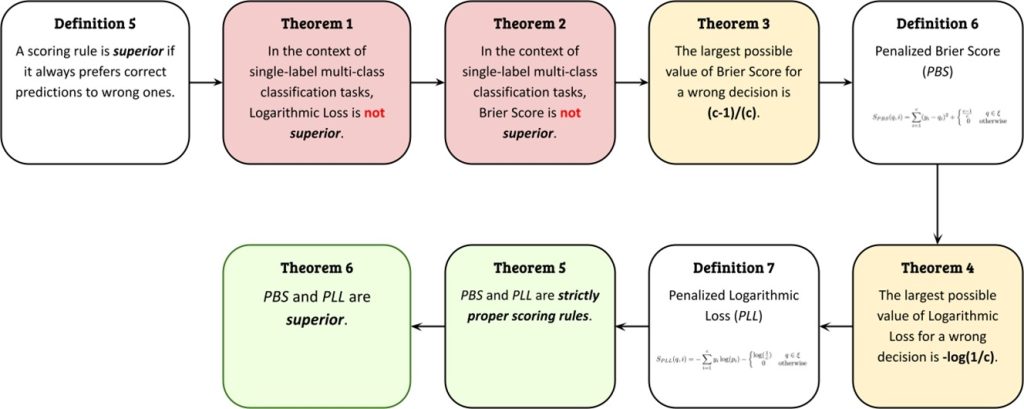
Ref: https://doi.org/10.1016/j.ijar.2025.109421
The full version of the paper “Superior scoring rules for probabilistic evaluation of single-label multi-class classification tasks” by Rouhollah Ahmadian, Mehdi Ghatee, & Johan Wahlström is now available online in “International Journal of Approximate Reasoning”. It can be downloaded by clicking the following Share Link before May 14, 2025. No sign up, registration, or fees are required.
Isfahan Artificial Intelligence Event 2023: Reflux Detection Competition
Journal of Medical Signals & Sensors
Authors & full citation
Isfahan Artificial Intelligence Event 2023: Reflux Detection Competition
By:
Kenari, Azra Rasouli; Montazerolghaem, Ahmadreza; Zojaji, Zahra; Ghatee, Mehdi; Yousefimehr, Behnam; Rahmani, Amin; Kalani, Mahdi; Kiyanpour, Farnoush; Kiani-Abari, Mohamad; Fakhar, Mohammad Yasin; Rezaei, Safiyeh; Tahernia, Mojtaba; Vafaie, Mohammad Hossein; Besharatnezhad, Hamidreza; Bafrani, Vahid Rahimi; Tofighi, Mohamad Taghi; Sedeh, Peyman Adibi; Soheilipour, Maryam; Rabbani, Hossein
has been accepted in “Journal of Medical Signals & Sensors”.
Abstract
Background:
Gastroesophageal reflux disease (GERD) is a prevalent digestive disorder that impacts millions of individuals globally. Multichannel intraluminal impedance-pH (MII-pH) monitoring represents a novel technique and currently stands as the gold standard for diagnosing GERD. Accurately characterizing reflux events from MII data are crucial for GERD diagnosis. Despite the initial introduction of clinical literature toward software advancements several years ago, the reliable extraction of reflux events from MII data continues to pose a significant challenge. Achieving success necessitates the seamless collaboration of two key components: a reflux definition criteria protocol established by gastrointestinal experts and a comprehensive analysis of MII data for reflux detection.
Method:
In an endeavor to address this challenge, our team assembled a dataset comprising 201 MII episodes. We meticulously crafted precise reflux episode definition criteria, establishing the gold standard and labels for MII data.
Result:
A variety of signal-analyzing methods should be explored. The first Isfahan Artificial Intelligence Competition in 2023 featured formal assessments of alternative methodologies across six distinct domains, including MII data evaluations.
Discussion:
This article outlines the datasets provided to participants and offers an overview of the competition results.
Keywords
24‑h monitoring, deep learning, Isfahan Artificial Intelligence Challenge, multichannel intraluminal impedance, reflux
Ref:
Journal of Medical Signals & Sensors 15(2):6, February 2025. | DOI: 10.4103/jmss.jmss_46_24
Resampled cost-sensitive Operational Machine learning Ensemble (ROME) framework for car insurance fraud detection
International Journal of Information and Communication Technology Research
Authors & full citation
Resampled cost-sensitive Operational Machine learning Ensemble (ROME) framework for car insurance fraud detection
By
Behnam Yousefimehr, Mehdi Ghatee, Ayin Ghazimoradi, Vista Farahifar
has been accepted in "International Journal of Information and Communication Technology Research".
Abstract
This study introduces a novel approach to enhance car insurance fraud detection through the ROME framework, which integrates resampling techniques with cost-sensitive machine learning. The philosophy behind this method stems from addressing two critical challenges in fraud detection: the imbalance in datasets and the high cost associated with misclassifying fraudulent cases. The resampling method ensures balanced data representation, while the cost-sensitive approach prioritizes reducing the misclassification impact, aligning with the industry's goal of minimizing financial losses. This hybrid strategy marks a significant advancement in fraud detection. The model was tested on real-world car insurance data, achieving an impressive F1 Measure of 76.32%, outperforming the CatBoost baseline by 31.25%. These results highlight the effectiveness of the combined approach in enhancing detection accuracy, equipping insurers with a robust tool for improved risk management. The findings offer substantial contributions to the insurance industry by bolstering the reliability and efficiency of fraud detection systems.
Keywords
Fraud detection; Car insurance; Resampling; Cost-sensitive; Machine learning
Additional source-archive excerpt: OCT study
This retained source-archive excerpt concerns a separate OCT study by Amin Rahmani and Mehdi Ghatee; it is not the reference or access link for the ROME study. The original notice remains below for the record. Its stated free-access deadline has passed. Read the separate OCT study.
Ref:
The full version of the paper “Fast inference in classification of optical coherence tomography (OCT) images for real-time retinal disease diagnosis” by Amin Rahmani & Mehdi Ghatee is now available online in “Biomedical Signal Processing and Control”. It can be downloaded by clicking the following Share Link before February 16, 2025. No sign up, registration, or fees are required.
Share Link:
Detecting Car Insurance Fraud Using Improved Clustering with Genetic Algorithm
Iranian Journal of Insurance Research (IJIR)
Authors & full citation
Detecting Car Insurance Fraud Using Improved Clustering with Genetic Algorithm
By
Behnam Yousefimehr, Mehdi Ghatee, Sina Moradi, Yasamin Tafakor, Sajed Tavakoli
has been accepted in "Iranian Journal of Insurance Research (IJIR)"
Abstract:
BACKGROUND AND OBJECTIVES: Clustering is one of the fundamental techniques in data mining and machine learning used to divide a dataset into homogeneous subsets. Various methods exist for clustering, each with its own strengths and weaknesses. One of the main challenges in clustering is finding the optimal number of clusters and the optimal assignment of data to these clusters. The genetic algorithm, as an optimization method based on natural evolution, has high capabilities in solving complex problems and searching large solution spaces and can be effectively used as a tool in clustering. This paper aims to evaluate the performance and accuracy of the genetic algorithm in clustering data and compare it with traditional clustering methods. To assess the performance of this algorithm, several insurance datasets were used, and the results were analyzed using various metrics such as accuracy, speed, and convergence. Additionally, different parameters of the genetic algorithm were examined to determine their impact on the final performance of the algorithm and to find the optimal settings for clustering data.
METHODS: In this study, to form chromosomes, the number of clusters was first specified. Given that each cluster center has as many features as the dataset, the length of each chromosome was determined by the product of the number of clusters and the number of features. Novel and diverse methods were employed for the processes of Crossover, Mutation, and Survival. Additionally, the fitness score was chosen similar to the k-means algorithm to optimize clustering performance. This innovative approach led to improved accuracy and efficiency in the clustering process.
FINDINGS: By applying the method described in this article to three insurance datasets for fraud detection, interesting results were obtained: a 27% improvement in F1 and a 6% increase in accuracy in the first dataset, a 1% improvement in F1 and a 2% improvement in accuracy in the second dataset, and finally a 2% improvement in F1 and a 9% improvement in accuracy in the third dataset compared to the K-means method and other approaches. Given the binary nature of the data in these datasets, the problem was solved using the algorithm for two clusters, and the best label for each cluster was chosen based on the actual labels of the data. The results were presented in the form of classification outcomes.CONCLUSION: The genetic algorithm has the capability to solve complex problems without definitive solutions and can outperform traditional methods like k-means in clustering data. Using various evaluation metrics such as Silhouette Score, Davies-Bouldin Score, and Adjusted Rand Index (ARI) in this algorithm allows for the improvement of cluster centers. This approach, by incorporating probabilities and randomness, enables the examination of more points as cluster centers and improves clustering performance. The results indicate that this method can, in some cases, perform better than well-known methods and provide a suitable structure for clustering data using the genetic algorithm.
DOI: 10.22056/ijir.2024.369483.3207
No matches. Try another keyword.